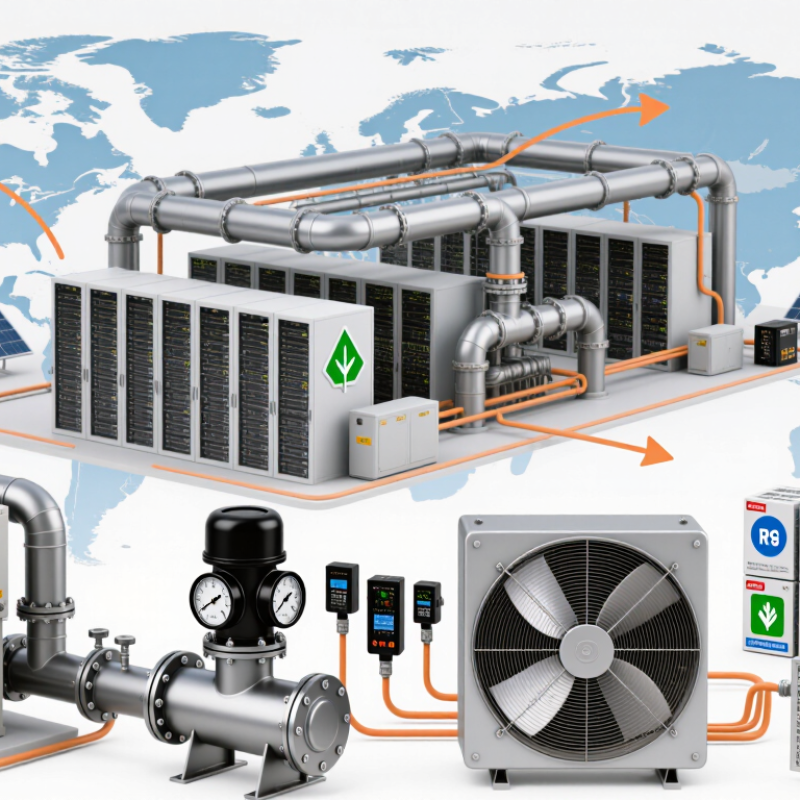
Choosing Cooling system components for global sourcing is no longer a simple price exercise. It is a reliability decision made across climates, regulations, suppliers, and service networks. The International Energy Agency reported that data centres consumed about 240 TWh of electricity globally in 2022. Demand could more than double by 2026, driven partly by artificial intelligence and high-density computing (IEA, Electricity 2024). Cooling efficiency now affects operating cost, carbon exposure, and equipment lifespan.
The details matter. A pump may meet its flow target, yet fail under unstable voltage or poor water quality. A fan may look inexpensive, but replacement delays can stop a complete facility. ASHRAE TC 9.9 recommends matching thermal design with actual operating conditions, not catalogue assumptions. Christian Belady, a former Microsoft data-centre executive, has stated, “The most efficient data center is the one you don’t build.” The principle is useful, though incomplete for global sourcing. Facilities still need resilient systems. This guide examines chillers, pumps, fans, heat exchangers, sensors, controls, and liquid-cooling assemblies. It also considers supplier qualification, spare-part availability, RoHS and REACH expectations, local certifications, and documentation quality. The Uptime Institute’s Global Data Center Survey repeatedly identifies outages and operational weaknesses as major business risks. A cheaper component can become expensive after customs delays, incompatible fittings, or missing maintenance data. That risk is easy to underestimate. Buyers should compare lifecycle performance, not only purchase quotations. Field experience often exposes weaknesses that spreadsheets miss. A careful sourcing plan therefore combines engineering evidence, supplier audits, regional support, and honest contingency planning.
When sourcing cooling system components globally, define the operating conditions before comparing suppliers.
Record heat load, ambient temperature, humidity, altitude, airflow, water quality, and available power. These details determine whether you need air cooling, liquid cooling, or a hybrid design.
The International Energy Agency estimated that data centers used about 240–340 TWh of electricity in 2022. Cooling can represent a significant share of that demand, especially in warm climates. A small design error can become a large operating cost.
Use measurable requirements. State the maximum inlet temperature, expected thermal load, allowable pressure drop, noise limit, and required service life. Include transient loads, not only average conditions.
ASHRAE’s thermal guidance emphasizes controlling equipment inlet conditions rather than relying only on room temperature. For international procurement, also verify voltage, frequency, connector standards, corrosion risks, and replacement-part availability.
The specification may still be incomplete. Field conditions often differ from laboratory assumptions. That uncomfortable gap deserves attention.
Tips: Create a single conditions sheet for every supplier. Test components at the highest expected ambient temperature, not the annual average. Request performance curves, efficiency data, material declarations, and independent test evidence. The Uptime Institute has repeatedly identified cooling and power resilience as major data-center reliability concerns. Therefore, ask how a component performs during partial failure, blocked airflow, or reduced water flow. Do not select by purchase price alone; compare energy use, maintenance access, logistics, and recovery time across its full operating life.
Cooling-system selection starts with comparing how each type rejects heat. Air-cooled systems use fans and finned coils, making installation simpler where water is scarce. Water-cooled systems use cooling towers, pumps, and plate or shell-and-tube heat exchangers. They often deliver better efficiency, but require water treatment and stronger maintenance controls. Evaporative systems can reduce condenser temperatures, although humidity and water quality limit their performance.
The International Energy Agency reported in The Future of Cooling that space-cooling electricity use has more than tripled since 1990 and may triple again by 2050. Component sourcing therefore affects both energy cost and reliability. Compressors provide refrigerant circulation. Condensers reject heat. Expansion valves control pressure. Evaporators absorb indoor heat. Sensors and controllers coordinate the system under changing loads.
Small details matter. A poorly matched fan can erase an efficient heat exchanger’s gains. A cheaper pump may consume more power throughout its service life. For global sourcing, compare pressure ratings, refrigerant compatibility, corrosion resistance, spare-part availability, and documented test results. The International Organization for Standardization and ASHRAE publish widely used performance and safety references, but supplier documents still need verification.
The choice is rarely perfect. A compact air-cooled unit may suit a dry warehouse, yet struggle beside a dusty loading area. Water-cooled equipment may perform better, but its treatment costs can be underestimated. Before approving a component, request sample inspection, lifecycle calculations, and operating data from comparable climates. Numbers can mislead when test conditions differ.
How to Choose Cooling System Components for Global Sourcing
Global sourcing of cooling components starts with evidence, not catalog promises. The International Energy Agency projects space-cooling energy demand could more than triple by 2050 (The Future of Cooling, 2018). That pressure makes material selection a performance decision. Copper offers strong thermal conductivity. Aluminum can reduce weight and cost. Yet salt spray, galvanic corrosion, vibration, and refrigerant chemistry can change the result. Request alloy grades, coating thickness, pressure ratings, and compatibility test records. Small details matter.
Standards must be mapped to the destination market before quotation. ISO 5149 addresses refrigerating systems and heat pumps. IEC 60335-2-40 covers safety for electrical heat pumps and air-conditioners. ASHRAE Standard 15 adds widely used refrigerant safety requirements. Requirements still vary by jurisdiction. Ask suppliers to identify test methods, certification scope, and renewal dates. A certificate without scope is weak evidence.
Supplier capability is more than production volume. Audit incoming inspection, brazing controls, leak testing, calibration, and batch traceability. The International Energy Agency’s World Energy Outlook 2023 notes that cooling demand is rising with higher temperatures and living standards. Require sample reports and independent validation for critical parts. I would also test packaging after humidity and vibration exposure. It is easy to miss. A spreadsheet cannot show workmanship inside a joint. Leave room for corrective action. No supplier is perfect, and neither is the buyer’s checklist. Review failure data quarterly, then adjust materials, tolerances, and audit depth.
| Component Category | Recommended Material Options | Typical Selection Criteria | Relevant Standards or Tests | Supplier Capability to Verify | Key Quality Evidence | Global Sourcing Risk |
|---|---|---|---|---|---|---|
| Heat Exchanger or Radiator | Aluminum alloys such as 3003, 5052, 6061, or 6063; copper alloys for high thermal conductivity applications; stainless steel where corrosion resistance is critical. | Thermal conductivity, pressure rating, corrosion resistance, wall thickness, weight, brazing compatibility, and operating temperature. | ASTM B209 for aluminum sheet; ASTM B241 for aluminum tube; ASTM B75 for copper tube; pressure and leak testing according to the approved design specification. | Controlled brazing or welding, fixture repeatability, fin and tube forming, clean-room or controlled-cleanliness processes where required, and thermal-performance testing. | Material certificates, chemical composition reports, dimensional inspection, pressure-decay or helium leak results, burst-test records, and thermal test curves. | Mixed alloy supply, inconsistent brazing quality, galvanic corrosion, and insufficient test capacity. |
| Cooling Hoses and Flexible Tubing | EPDM for water-glycol coolant; silicone rubber for high-temperature flexibility; fluorocarbon elastomers for selected chemical or temperature demands; reinforced thermoplastic hose for higher pressure. | Coolant compatibility, temperature range, working and burst pressure, bend radius, permeation, vibration resistance, and clamp retention. | SAE J20 for automotive coolant hose applications; ISO 6803 for impulse testing of hydraulic hose assemblies where applicable; ASTM D380 and ASTM D471 test methods may support hose evaluation. | Extrusion or molding control, reinforcement placement, cut-length accuracy, assembly capability, and testing with the actual coolant formulation. | Rubber compound specification, hardness results, tensile and elongation data, dimensional reports, pressure-test records, and coolant-aging results. | Premature swelling, cracking, coolant permeation, incorrect compound substitution, and poor clamp compatibility. |
| Coolant Pump | Aluminum or stainless-steel wetted housing; ceramic or hardened stainless-steel shaft; EPDM or FKM seals; engineering plastics for selected impellers or covers. | Flow rate, head pressure, efficiency, electrical input, noise, cavitation margin, coolant compatibility, and continuous-duty capability. | IEC 60034 for rotating electrical machines where applicable; IEC 60529 for enclosure protection; electrical safety and EMC tests based on the destination market. | Pump curve testing, motor winding control, balancing, seal installation, end-of-line electrical inspection, and traceable calibration of flow equipment. | Flow-head curves, efficiency data, insulation resistance, dielectric-strength test records, vibration readings, noise measurements, and life-test reports. | Unverified performance curves, motor variation, seal leakage, voltage incompatibility, and inadequate after-sales repair support. |
| Cooling Fan and Motor Assembly | Glass-fiber-reinforced polyamide or polypropylene blades; aluminum or coated steel frames; copper windings; sealed bearings suitable for the specified environment. | Airflow, static pressure, operating temperature, power consumption, acoustic level, speed control, dust and moisture exposure, and service life. | IEC 60529 for IP protection; IEC 60034 for motor performance where applicable; ISO 13350 may support fan-performance evaluation; applicable EMC requirements for electronic controls. | Fan curve testing, rotor balancing, motor assembly, programmable controller testing, acoustic measurement, and environmental chamber testing. | Airflow-pressure curves, current draw, speed-control verification, vibration results, noise data, IP test reports, and accelerated-life-test records. | Performance loss caused by grille design, bearing noise, controller incompatibility, and weak protection against dust or water. |
| Valves, Fittings, and Manifolds | Brass, stainless steel, anodized aluminum, or engineered polymers selected according to coolant chemistry, pressure, and temperature. | Connection type, flow restriction, pressure rating, corrosion resistance, sealing method, serviceability, and dimensional interchangeability. | ISO 7-1 for pipe threads where applicable; ISO 228-1 for parallel pipe threads; ISO 5211 may apply to valve actuator interfaces; pressure and leak tests are required. | CNC machining, deburring, surface treatment, thread-gauge control, automated leak testing, and capability to maintain critical sealing dimensions. | Thread and dimensional reports, plating or anodizing records, pressure-test results, seal-material certificates, and lot traceability. | Thread incompatibility, burrs or contamination, leakage after thermal cycling, and undocumented material changes. |
| Seals, Gaskets, and O-Rings | EPDM for water-based glycol coolant; FKM for higher-temperature or selected chemical environments; silicone for specific temperature and flexibility requirements; PTFE for low-friction or chemical-resistance needs. | Compression set, temperature range, coolant compatibility, hardness, surface finish, groove design, and resistance to aging. | ISO 3601 for O-rings; ASTM D395 for compression set; ASTM D471 for fluid effects on elastomers; material-specific qualification testing. | Compound formulation control, mold accuracy, flash removal, automated visual inspection, and batch-level material traceability. | Compound batch records, hardness, dimensional inspection, compression-set data, fluid-immersion results, and visual inspection records. | Incorrect elastomer selection, swelling, compression loss, sealing-surface damage, and mixed batches. |
| Temperature, Pressure, and Flow Sensors | Stainless-steel wetted parts, nickel-plated brass, ceramic sensing elements, glass-filled polymers, and fluoropolymer or elastomer seals. | Accuracy, repeatability, response time, signal type, calibration range, electrical protection, connector compatibility, and long-term drift. | IEC 60529 for ingress protection; IEC 61326-1 for measurement and laboratory equipment EMC where applicable; ISO 17025 for calibration-laboratory competence. | Calibration capability, environmental testing, electronic assembly, software or firmware control, connector sealing, and serial-number traceability. | Calibration certificates, accuracy maps, hysteresis results, temperature-cycle data, EMC reports, firmware revision records, and incoming inspection plans. | Calibration drift, signal noise, connector mismatch, moisture ingress, and undocumented firmware changes. |
| Reservoirs, Expansion Tanks, and Covers | High-temperature polypropylene, polyamide, aluminum, or stainless steel, depending on pressure, temperature, visibility, and chemical exposure. | Volume, pressure rating, coolant compatibility, weld or seam integrity, cap sealing, UV exposure, and mounting stability. | ASTM D638 for tensile properties of plastics; ASTM D648 for heat-deflection temperature; pressure, thermal-cycle, and leak testing according to the product specification. | Injection molding or metal fabrication, weld validation, dimensional control, pressure testing, and capability to manage mold or tooling changes. | Resin or metal certificates, weld-strength records, pressure-test results, thermal-aging data, dimensional reports, and tooling-change approval records. | Stress cracking, warpage, cap leakage, UV degradation, and uncontrolled tooling modifications. |
| Supplier Quality and Management System | Not material-specific; applies to the complete sourcing program and component supply chain. | Process maturity, change control, corrective-action speed, capacity, traceability, sub-supplier management, and continuity planning. | ISO 9001 for quality management; ISO 14001 for environmental management; ISO 45001 for occupational health and safety; ISO 19011 for management-system auditing guidance. | Documented process controls, FMEA and control-plan discipline, calibrated equipment, production-capacity planning, internal audits, and formal engineering-change procedures. | Valid certificates from accredited bodies, audit reports, process capability studies, nonconformance records, corrective-action reports, and business-continuity plans. | Certificate scope gaps, weak sub-supplier control, capacity overstatement, slow corrective action, and single-source dependency. |
| Packaging, Logistics, and Export Readiness | Moisture-resistant packaging materials, corrosion inhibitors for metal parts, protective caps, impact protection, and recyclable packaging where feasible. | Transit damage prevention, humidity exposure, shelf life, customs documentation, pallet efficiency, dangerous-goods status, and regional labeling needs. | ISPM 15 for regulated wood packaging; ASTM D4169 or ISTA test procedures for distribution-performance evaluation; applicable import and labeling rules of the destination country. | Export documentation, packaging validation, lot identification, shipment inspection, multi-region logistics experience, and contingency routing. | Packaging qualification reports, packing lists, certificates of origin where required, inspection photographs, barcode or lot records, and shipping-damage data. | Corrosion during ocean freight, customs delays, incorrect documentation, transit impact, and regional compliance gaps. |

Global sourcing of cooling components requires more than comparing prices. Verify measured capacity, energy efficiency, noise, pressure limits, and operating temperature ranges. The IEA’s The Future of Cooling reports that space-cooling energy demand could more than triple by 2050 without stronger efficiency measures. This makes performance data commercially important. Request test conditions, tolerances, and life-cycle results, not just catalogue ratings. A condenser rated at 35°C may perform differently in a 45°C warehouse. Small assumptions can become expensive failures.
Compatibility deserves equal attention. Confirm refrigerant type, oil compatibility, electrical frequency, connector dimensions, control signals, and corrosion protection. ASHRAE Standard 34 provides refrigerant safety classifications, while ISO 5149 addresses refrigeration system safety and environmental requirements. These references support technical reviews, but they do not replace local certification. Regulatory duties also vary by destination. The EU F-gas Regulation 2024/573 strengthens controls on fluorinated gases, including equipment restrictions and reporting obligations. A component can pass factory testing and still fail import or installation requirements.
Tips: Build a compliance matrix before ordering samples. Record each country’s refrigerant rules, efficiency thresholds, documentation requirements, and responsible importer. Ask suppliers for recent laboratory reports and serialised test records. Check whether certificates cover the exact model revision. This step is often overlooked. It should not be. Independent inspection can verify dimensions, materials, and electrical safety before shipment. Still, no checklist catches every field condition; pilot testing in the target climate remains the more reliable decision.
Global sourcing should begin with the full lifecycle, not the lowest quotation. In my procurement projects, a cheaper pump often created higher costs through spare parts delays and difficult servicing. Select components with clear specifications, documented test results, and stable production capacity. Check voltage, refrigerant compatibility, water quality limits, and ambient temperature ranges before approval. These details prevent costly redesigns at the destination.
Logistics also needs engineering input. Confirm packaging dimensions, lifting points, moisture protection, and storage requirements before booking transport. A heat exchanger may arrive safely but remain unusable after months in a humid warehouse.
Divide shipments by project risk, not only by supplier location. Keep critical seals, sensors, and control parts near the installation site. Local technical partners can shorten response times, but their training and availability must be verified. Our early delivery plan was too optimistic. Seasonal port congestion exposed that weakness.
Tips: Build a total-cost model covering purchase, freight, duties, installation, energy use, maintenance, and disposal. Request manuals, certificates, inspection records, and recommended spare-part lists. Use a small pilot order when specifications are uncertain. Record every change in a shared approval file. Review supplier performance after commissioning, not just after delivery. That review may reveal overlooked noise, access, or cleaning issues. Lifecycle support is never fully predictable. Plan for adjustments.