
Buying an Electric Folding Scooter looks simple until real journeys begin. A showroom floor cannot reveal every weakness. A steep curb, wet pavement, crowded train, or loose charging port can change the experience quickly. Global buyers also face different roads, climates, service networks, and riding expectations.
This guide examines ten practical buying tips for choosing more confidently. It considers motor performance, battery range, folding design, weight, braking systems, tire construction, lighting, water resistance, repair support, and total ownership cost. Claimed range deserves careful attention. Manufacturers often measure it under ideal conditions, with a light rider, flat roads, and moderate speed. Actual distance may fall in cold weather or on hills.
Horace Dediu, a respected micromobility analyst, describes the field as “the movement of people and goods over short distances.” That short trip still requires thoughtful engineering. A portable scooter must fit beside a desk, inside a vehicle, or under a train seat. It should also feel stable when the road surface becomes uneven.
There is no perfect model. Trade-offs remain.
A larger battery may increase weight. Smaller wheels may improve portability but reduce comfort. More power may help on slopes, yet it can raise energy use and price. Some buyers focus too heavily on speed. That can be a mistake. Reliable brakes, visible lights, a secure folding latch, and accessible service may matter more during everyday travel.
The following tips combine technical evaluation with practical judgment. They also acknowledge an uncomfortable truth: the cheapest scooter may become the most expensive choice after repeated repairs.
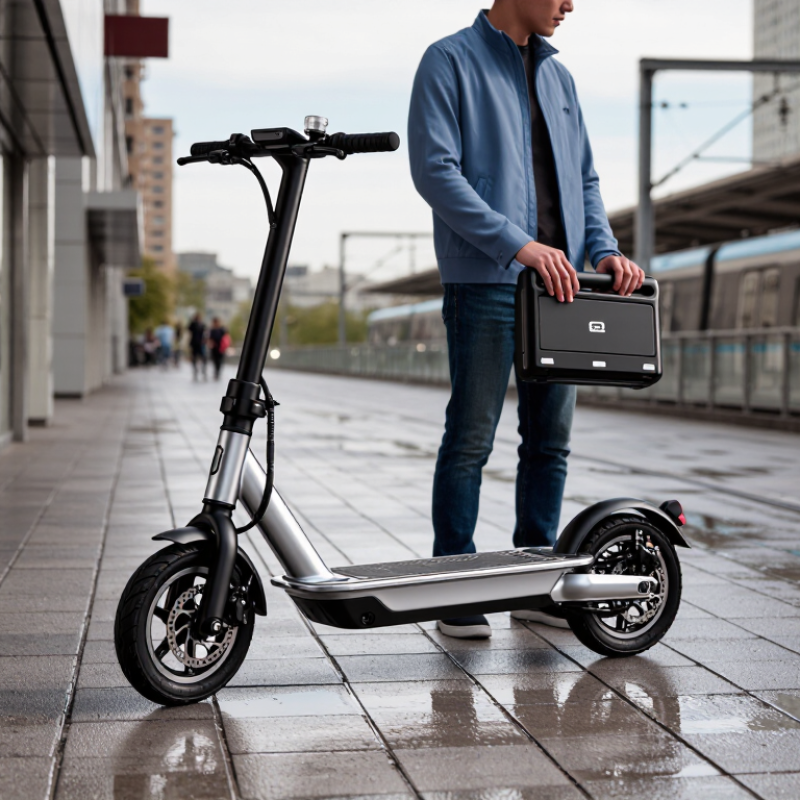
Before comparing electric folding scooters, define where and how you will ride. A short city commute needs different features than a daily last-mile connection. Measure your usual route, including steep ramps, uneven pavement, crowded sidewalks, and train platforms. Note the real carrying distance after folding. Ten minutes of lifting can feel surprisingly demanding.
Your use case should guide the scooter’s size, motor output, battery range, and wheel design. For apartment storage, check the folded height beside your desk or doorway. For public transport, confirm the packed weight and whether the vehicle allows folded scooters.
If your route includes hills, allow extra power instead of trusting the advertised maximum range. Cold weather, heavy loads, and frequent stops can reduce practical distance. A helmet, lights, and reliable brakes also matter, even for short trips.
Do not design around an ideal day. Test the decision against rain, missed connections, and a nearly empty battery. Your first range estimate may be too optimistic. That is worth admitting. Record your rider weight, bag weight, route length, and charging access before buying. Local transport and safety requirements can differ, so verify them with official sources. A folding scooter should fit your routine, not force your routine to change. If you mainly carry it upstairs, low weight may matter more than speed. If you ride over rough surfaces, stability may matter more than compact folding.
Motor power is only one part of an electric folding scooter’s performance. A higher wattage rating can improve hill climbing, but it may also increase battery consumption. Check both rated and peak power, especially if your route includes steep roads or frequent stops. The IEA Global EV Outlook 2024 identifies electric two- and three-wheelers as one of the most electrified road-transport segments in several Asian markets. That trend makes efficiency and reliability increasingly important.
Battery range should be compared carefully. A published figure often assumes a light rider, flat roads, moderate speed, and warm weather. Real-world range can be shorter. Very short, sometimes. Look for battery voltage, amp-hours, and watt-hours; watt-hours equal voltage multiplied by amp-hours. A larger battery usually offers more usable range, but it also adds weight. That trade-off is easy to underestimate.
Charging requirements deserve equal attention. Confirm the input voltage, plug type, charging time, and charger certification before purchase. A plug adapter does not convert voltage. The U.S. Department of Energy notes that charging performance can vary with temperature, battery condition, and charging equipment. Allow ventilation around the charger, avoid damaged cables, and follow the supplied charging limits. Some product specifications remain optimistic, so leave a practical range margin for hills, cold mornings, and battery aging.
| No. | Buying Dimension | What to Check | Why It Matters |
|---|---|---|---|
| 1 | Motor Power | For urban commuting, compare continuous rated power around 250–500 W. Higher power can help on hills, but local rules may limit motor output or speed. | Rated power is more useful than a short peak-power figure for judging sustained performance, hill climbing, and acceleration. |
| 2 | Battery Capacity and Real-World Range | Calculate battery energy in watt-hours: Voltage × Amp-hours = Wh. A 36 V, 10 Ah battery stores about 360 Wh. Treat advertised range as an ideal maximum and expect lower results in cold weather, hills, wind, heavy-load use, or high speeds. | Battery capacity provides a more comparable basis than a marketing range claim. Leave a practical reserve rather than planning to use 100% of the stated range. |
| 3 | Charging Requirements | Confirm the charger’s input voltage and frequency, such as 100–240 V AC and 50/60 Hz, as well as the scooter battery’s charging voltage. Check whether the plug type matches the destination country. | Electrical standards and plug shapes differ worldwide. A compatible charger reduces the risk of unsafe operation, adapter problems, or delayed charging. |
| 4 | Charging Time and Battery Care | Compare the stated charging time, commonly about 4–8 hours for many commuter batteries. Use the supplied or approved charger, charge in a dry ventilated area, and avoid charging a damaged or unusually hot battery. | Charging time affects daily convenience, while correct charging practices help reduce battery stress and safety risks. |
| 5 | Weight and Folded Size | Check total scooter weight, folded dimensions, carrying points, and whether it fits in a car trunk, under a desk, or on permitted public transport. Many practical folding models weigh approximately 12–20 kg. | A scooter that is difficult to carry or store may be inconvenient even when its motor and battery specifications are suitable. |
| 6 | Maximum Load | Compare the manufacturer’s maximum rider-and-cargo load with the actual combined weight. Select additional capacity if regular riding includes a backpack, luggage, or steep routes. | Exceeding the load limit can reduce braking performance, range, stability, tire life, and motor efficiency. |
| 7 | Braking and Safety Equipment | Look for independently operated front and rear braking, progressive control, bright front and rear lights, reflectors, a reliable bell or horn, and a visible battery or speed display. | Effective braking and visibility are important in traffic, at night, and on wet or crowded streets. Local regulations may specify required equipment. |
| 8 | Tires, Suspension, and Surface Conditions | Choose tire size and type according to the route. Pneumatic tires generally provide more cushioning but can puncture; solid or air-filled alternatives require different maintenance. Check the permitted terrain and suspension design. | Tires and suspension affect comfort, grip, handling, and puncture risk. Most commuter scooters are intended for paved surfaces rather than rough off-road use. |
| 9 | Weather Resistance | Review the exact ingress-protection rating, such as IPX4 or IPX5, and follow the manual’s limits. Avoid deep puddles, flooding, pressure washing, and charging when the charging port is wet. | An IP rating describes protection under specified test conditions; it does not mean the scooter is waterproof or safe to submerge. |
| 10 | Local Laws, Certification, and Support | Before purchase, verify permitted speed, motor-power limits, minimum rider age, helmet rules, road or cycle-lane access, registration, lighting requirements, and battery transport rules. Also check spare parts and warranty support in the destination country. | Regulations vary by country and sometimes by city. Legal compliance and access to service can be as important as performance specifications. |
Portability begins with real carrying weight, not the catalog number. Grand View Research estimated the global electric scooter market at about USD 4.6 billion in 2023. That growth increases choice, but specifications still vary widely. During practical checks, lift the scooter with one hand and walk ten meters. A 15-kilogram model may feel manageable, while poor balance makes it awkward. Check the folded length before choosing public transport or a small car.
Tip: Examine the folding design closely. A secure latch should close without forcing it. Test the hinge several times, because a clever mechanism can become frustrating after daily use. A compact deck saves space, but narrow handlebars may reduce comfort. This is where I sometimes changed my preference. Smaller was not always easier.
Tip: Measure storage, not just the scooter. Compare the folded height with a closet shelf, office corner, or apartment doorway. The International Energy Agency reports that electric two- and three-wheelers are among the fastest-growing electric vehicle segments globally. More users may mean tighter storage spaces. Look for a stable folded position, protected cables, and wheels that roll without scraping. Lightweight materials help, but very low weight can reduce durability. Check the maximum load, wheel size, and warranty terms from independent testing sources before paying.
When evaluating an electric folding scooter, inspect safety details before admiring its appearance. Check whether the braking system responds smoothly, without a sudden grab. Dual braking can provide better control on wet or crowded streets. Test the headlight, rear light, and reflectors in dim conditions. Visibility matters more than glossy paint. The folding stem should lock firmly and resist side-to-side movement. A loose hinge is a serious warning sign. Examine the tires too. Wider pneumatic tires usually absorb cracks better, while solid tires reduce puncture worries.
Ride comfort depends on more than suspension. Stand on the deck and check whether both feet fit naturally. Your knees should remain slightly relaxed. Adjustable handlebars help different riders maintain a neutral wrist position. On a short test ride, notice vibration through the grips after passing over rough pavement. Excessive shaking can reduce confidence quickly. I would not judge comfort from a showroom floor alone. That surface is often unrealistically smooth.
Build quality appears in small details. Look for clean welds, protected wiring, and a frame that feels rigid when folded. Check the hinge, latch, and carrying handle repeatedly. These parts receive frequent stress during daily use. Confirm the stated load capacity, but treat it as a limit, not a target. One imperfect habit is relying on specifications without checking real assembly quality. A careful buyer should also inspect replacement-part access and clear maintenance instructions before purchase.
Suggested evaluation weighting for comparing folding electric scooters, with the strongest emphasis on safety, battery protection, braking, and structural reliability.
How to use this chart: Prioritize scooters with verifiable safety certifications, dependable braking, protected batteries, secure folding mechanisms, comfortable tires, and durable frames. Check local regulations, charging compatibility, spare-parts availability, and warranty coverage before purchasing.
Before buying an electric folding scooter, check the rules where you will ride and store it. Requirements may cover maximum speed, motor output, rider age, helmets, lights, insurance, registration, and road access. A model permitted on private property may still be restricted on public streets. The U.S. Consumer Product Safety Commission estimated 233,870 micromobility-related emergency-department injuries from 2017 to 2022. That figure covers several product types, but it shows why legal and safety checks deserve practical attention.
Warranty details can be more important than a low purchase price. Read whether coverage applies in your destination country, not only the seller’s home market. Check battery duration, water-damage exclusions, shipping responsibility, labor fees, and return deadlines. McKinsey’s 2019 micromobility report projected a global market worth $300–500 billion annually by 2030, increasing the need for dependable support systems. Large market forecasts do not guarantee local service.
Ask for a written repair process before paying. Can a nearby technician diagnose the controller, charger, folding latch, and battery? Are replacement parts available in your region? Request service contacts in your language, expected response times, and clear escalation steps. Keep the invoice, serial number, and inspection photos. That habit feels excessive until a charger fails abroad. I have seen buyers trust verbal promises too much. That is a mistake worth questioning. Also confirm whether software support remains available after purchase, because a functioning scooter can still become difficult to maintain.