
7 Tips to Choose Durable Cooling Systems?

Choosing a cooling system is not simply a matter of comparing cooling capacity and purchase price. It is a long-term decision involving energy use, maintenance access, climate exposure, controls, and replacement parts. The International Energy Agency’s The Future of Cooling report states that space-cooling demand could more than triple by 2050. That projection makes Cooling system durability a practical business and household concern, not a marketing phrase.

The U.S. Department of Energy reports that heating and cooling represent about 48% of energy use in a typical American home. A durable system can therefore reduce repeated repairs, uncomfortable temperature swings, and unnecessary energy waste. Look beyond impressive efficiency labels. Check compressor protection, corrosion resistance, operating-temperature limits, warranty conditions, and local technician support. Small details matter. A poorly sealed outdoor cabinet may collect moisture, dust, and salt near a coastline. That damage often begins quietly.

ASHRAE standards provide valuable guidance for equipment performance, installation, ventilation, and indoor environmental quality. The UNEP-led Cooling Emissions and Policy Synthesis Report also highlights the importance of efficient cooling equipment and lower-impact refrigerants. Still, no report can predict every building’s future. A system selected for a mild warehouse may struggle in a crowded kitchen or a dusty workshop. I have seen specifications look excellent on paper, while poor drainage shortened service life. That possibility deserves attention. The following seven tips connect professional standards with real operating conditions, helping buyers judge durability before installation rather than after the first breakdown.
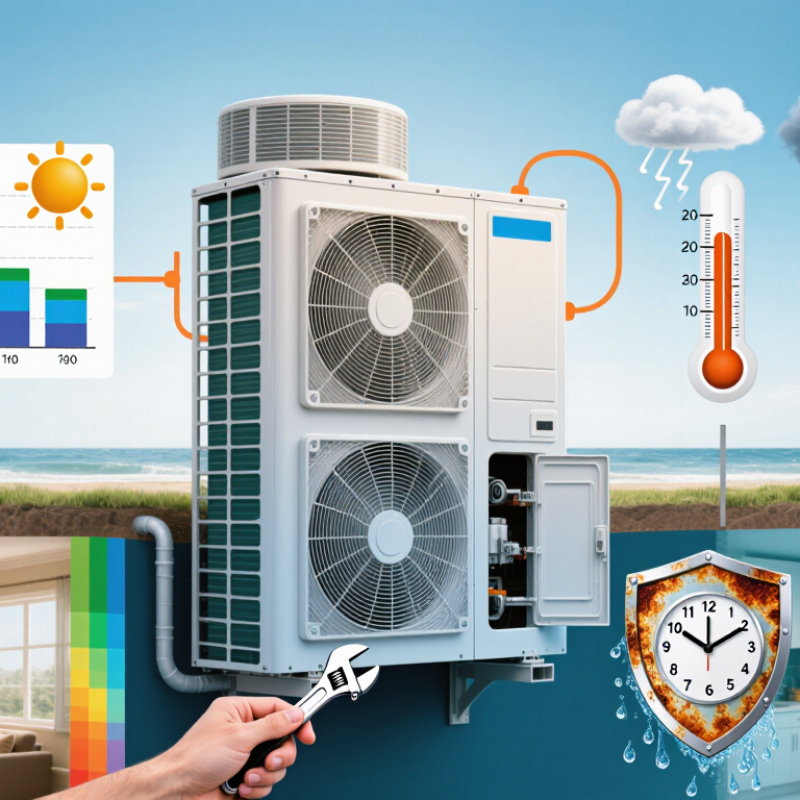
7 Tips to Choose Durable Cooling Systems?

Define Durability Through Warranty, Parts Support, and ASHRAE 180 Maintenance

Tip 1: Read the warranty as an operating document, not a sales promise. Check coverage length, compressor protection, labor terms, and exclusions. A long warranty can still disappoint. Ask whether poor maintenance voids coverage. In my experience, unclear language creates expensive arguments after installation. Request written examples of approved service records and response times.

Tip 2: Test parts support before choosing the cooling system. Ask how quickly common filters, belts, sensors, and fan motors can arrive. Confirm whether trained technicians are available near the site. A low purchase price means little when a small sensor stops production. Keep a list of critical spare parts. Some suppliers recommend this, but many facilities delay it until the first failure.

Tip 3: Compare the maintenance plan with ASHRAE Standard 180 guidance. The plan should identify inspection frequencies, coil cleaning, airflow checks, electrical testing, and documentation. Look for clear responsibilities between owners and contractors. A technician should record temperatures, pressure readings, unusual vibration, and corrective actions. Photos help. They also reveal neglected areas that checklists may miss. Review these records quarterly and question repeated repairs. Durability is not only strong equipment; it is disciplined care over years.

Compare SEER2 and EER2 Ratings with DOE Minimum Efficiency Standards

7 Tips to Choose Durable Cooling Systems

Tip 1: Compare SEER2 and EER2 ratings separately. SEER2 estimates seasonal efficiency across changing temperatures. EER2 measures performance under one fixed outdoor condition. A system may show a strong SEER2 rating but perform less impressively during extreme heat. Tip 2: Check the current DOE minimum efficiency standard for your region and equipment type. These standards are legal baselines, not guarantees of durability. Requirements can differ between split systems and packaged units.

Tip 3: Compare matching equipment categories. Do not place one system’s SEER2 beside another system’s EER2. That comparison misleads. Tip 4: Confirm ratings in certified product documentation, not only sales materials. Look for the complete system combination, including the indoor coil and outdoor unit. Tip 5: Consider local weather. In a long, hot summer, higher SEER2 may reduce seasonal electricity use. In very hot afternoons, EER2 deserves closer attention.

Tip 6: Demand a proper load calculation before installation. Oversized equipment cycles too often and may remove less humidity. That feels uncomfortable. Tip 7: Inspect practical durability details, including corrosion protection, sealed electrical connections, accessible filters, and a serviceable layout. A durable cabinet cannot rescue poor installation. I have seen efficient equipment underperform because ducts leaked, airflow was restricted, or maintenance was postponed. The rating matters, but field conditions matter too.

Match Cooling Capacity to Manual J Loads and ASHRAE 55 Comfort Criteria

7 Tips to Choose Durable Cooling Systems

Match Cooling Capacity to Manual J Loads and ASHRAE 55 Comfort Criteria

Durable cooling begins with accurate sizing, not the largest available unit. A Manual J calculation estimates heat gain from walls, windows, roofs, occupants, lighting, and infiltration. It also reflects window orientation and local climate. Ask for the design conditions behind the result. A vague “square-foot rule” can hide serious errors.

Capacity must match both sensible and latent loads. An oversized system may cool the room quickly but remove too little moisture. The space can feel clammy, especially near exterior doors. Short cycling also increases starts, stops, and mechanical stress. A slightly smaller system may run longer and control humidity more steadily. This is where real buildings often challenge neat calculations.

ASHRAE 55 adds the human comfort view. Check air temperature, radiant temperature, humidity, air speed, clothing, and activity. A thermostat reading of 24°C does not guarantee comfort beside a sunny window. Review diffuser locations, return-air paths, and room-by-room temperatures. Measure after installation, not only during design. Technicians should verify airflow, refrigerant performance, controls, and drainage. I have seen otherwise sound equipment perform poorly because a return grille was blocked by furniture. The lesson is uncomfortable: load calculations need field judgment. Recheck assumptions when occupancy, insulation, or window shading changes. Accessible filters and drain pans also support dependable operation over time.

Verify Performance with AHRI 210/240 Tests and ENERGY STAR’s 10% Benchmark

Choosing a durable cooling system requires more than checking its advertised cooling capacity. Ask for independent performance data under AHRI 210/240 test conditions. These tests compare cooling output and efficiency under controlled temperatures, helping you judge systems fairly.

Tip: Request the certification sheet, not just a sales estimate. Check the tested capacity, energy efficiency ratio, and operating conditions. A unit may perform well in a showroom but struggle during a 38°C afternoon. That difference matters.

Use the ENERGY STAR 10% benchmark as a practical screening point. Look for equipment rated at least 10% above the applicable minimum efficiency requirement. Higher efficiency can reduce operating costs and lower compressor stress over time. However, ratings are not promises for every home. Poor duct sealing, incorrect refrigerant charge, or an oversized unit can waste energy.

Tip: Match the test data to your installation plan. Experienced technicians should measure room load, airflow, duct losses, and electrical supply before recommending capacity. I once saw a high-rated unit installed with restricted return airflow. Its label looked excellent, but comfort remained uneven. That mistake is easy to overlook.

Keep the documentation. Compare two or three verified test reports, and question unusually high claims. Some specifications seem precise, yet real performance depends on maintenance and installation quality. A washable filter, clear outdoor coil, and annual inspection also support longer service life. Check the details.

7 Tips to Choose Durable Cooling Systems? - Verify Performance with AHRI 210/240 Tests and ENERGY STAR’s 10% Benchmark

Tip What to Check How to Verify It Why It Matters
1. Confirm ratings for the complete system Check that the indoor and outdoor components are an approved matched combination, with efficiency ratings determined under the applicable AHRI 210/240 procedures. Look up the exact combination in the AHRI Certified Product Directory and compare its certificate with the equipment proposal. Published performance can depend on the specific matched components; ratings for one combination may not apply to another.
2. Compare the right efficiency metrics Review SEER2 for seasonal cooling efficiency and EER2 for efficiency at a specified operating condition. For heat pumps, also review HSPF2 for seasonal heating performance. Use the same metric and rating basis when comparing systems, and confirm the figures on the matched-system record or product documentation. A higher efficiency rating can reduce energy use, but actual consumption also depends on climate, installation, controls, and operation.
3. Use ENERGY STAR’s 10% benchmark carefully ENERGY STAR states that certified central air conditioners are at least 10% more efficient than standard models. Applicable qualification criteria can vary by product type, region, and program revision. Check the current ENERGY STAR product criteria and certified-product listing for the exact system; do not treat the 10% figure as a universal threshold for every cooling product. Certification offers a useful efficiency screen, but it is not a guarantee of service life or a substitute for checking installation quality.
4. Insist on a proper load calculation Ask for a room-by-room heating and cooling load calculation that considers factors such as local climate, insulation, windows, orientation, air leakage, and occupancy. Request the calculation and proposed capacity in writing. Do not rely only on the size or capacity of the existing unit. Oversized equipment may cycle frequently and can provide poorer humidity control; undersized equipment may struggle to meet the load.
5. Inspect materials and installation location Ask about coil and cabinet materials, protective coatings where appropriate, drainage, clearance for airflow, and protection from debris or standing water. Check the installation plan and equipment documentation, especially for coastal, humid, or otherwise corrosive environments. Corrosion, blocked airflow, and poor condensate drainage can contribute to damage or reduced performance. Suitability depends on the site and maintenance.
6. Check serviceability and parts access Confirm that filters, coils, electrical components, and condensate pathways can be inspected and serviced, and ask how replacement parts are sourced. Review the installation layout, operating and maintenance instructions, and local service availability before purchase. Accessible components make routine maintenance and diagnosis easier; no design feature alone guarantees long-term reliability.
7. Review warranty and maintenance requirements Read the written terms for parts coverage, registration deadlines, exclusions, and required maintenance. Confirm what labor and service costs are not covered. Keep the warranty documents, installation records, and maintenance history. Follow the equipment instructions for filter care and professional inspection. Clear coverage terms and routine care help owners plan for upkeep; warranty length should not be treated as proof of expected lifespan.

Note: AHRI 210/240 ratings describe standardized equipment performance, not a guarantee of durability. System life and efficiency also depend on correct sizing, installation, operating conditions, and maintenance.

Assess Refrigerants, Safety, and Serviceability Under EPA and ASHRAE Standards

7 Tips to Choose Durable Cooling Systems

Tip 1: Check the refrigerant’s future. The U.S. Environmental Protection Agency requires an 85% HFC phasedown by 2036 under the AIM Act. A refrigerant with lower global warming potential may reduce future compliance and replacement risks. However, low-GWP does not automatically mean safer or easier to service. Check availability, recovery procedures, and technician training.

Tip 2: Read the safety classification. ASHRAE Standard 34 identifies refrigerants by toxicity and flammability, while Standard 15 addresses system installation and occupied-space protection. A2L refrigerants require careful leak detection, ventilation, electrical controls, and charge-limit calculations. Ask whether the equipment design follows the latest applicable editions. Small oversights matter.

Tip 3: Inspect serviceability before purchase. Look for accessible filters, labeled isolation valves, replaceable sensors, and clear diagnostic codes. Service manuals should state recovery requirements and compatible components. The International Energy Agency reports that cooling already uses about 10% of global electricity, with demand potentially tripling by 2050. Efficient operation depends on maintenance, not ratings alone.

Tip 4: Request documented performance data. Compare seasonal efficiency under realistic temperatures, not only laboratory conditions. EPA ENERGY STAR guidance emphasizes proper sizing, airflow, and regular maintenance. An oversized unit may cycle frequently and remove less humidity. That detail is easy to miss.

Tip 5: Verify the service network. Confirm trained personnel, refrigerant recovery equipment, spare-part access, and response times. A durable system that cannot be repaired quickly is not truly durable. This is where many evaluations become too optimistic.